Internal tool
Venor
- Role
- Solo design and build
The problem
Ultra Studio needed a steady way to find and qualify the right companies to reach out to, and to trust that shortlist. The hard part isn't collecting names; it's producing a score you can actually explain, without pretending to know more than you do.
Context & constraints
- This is not a product for sale: no users, no sign-up, no billing.
- A private repository, in daily use at the studio; it runs on public sources.
Architecture
The heavy work (discovery, Playwright and Lighthouse crawls, Claude's visual read of each site) runs locally as CLI scripts and writes a finished results.json. The panel on Vercel only reads it, so Chromium, memory and long-running jobs stop at the deployment line; past it there's nothing but light CRUD.
Design decisions
- Keep the browser off the server: Playwright, Lighthouse and Claude run locally, the panel gets finished JSON.
- Chromium should never boot inside a serverless function.
- An explainable score, not a magic number: five dimensions, campaign weights validated to sum to 1, data confidence reported separately.
- A score you can justify is worth more than one you can only display.
- Work that survives a re-run: analytics and CRM state in two stores, keyed by workspace, campaign and company.
- Re-exporting fresh data must never wipe a day of CRM work.
- Exports built in the browser: the audit PDF and CSV are generated client-side.
- No endpoint, no job queue, no server-side Chromium.
The solution
A prospecting system that carries the work from a raw signal to the next action: it discovers companies from public sources, scores their fit to a specific service and keeps the follow-up state, with no heavyweight backend.
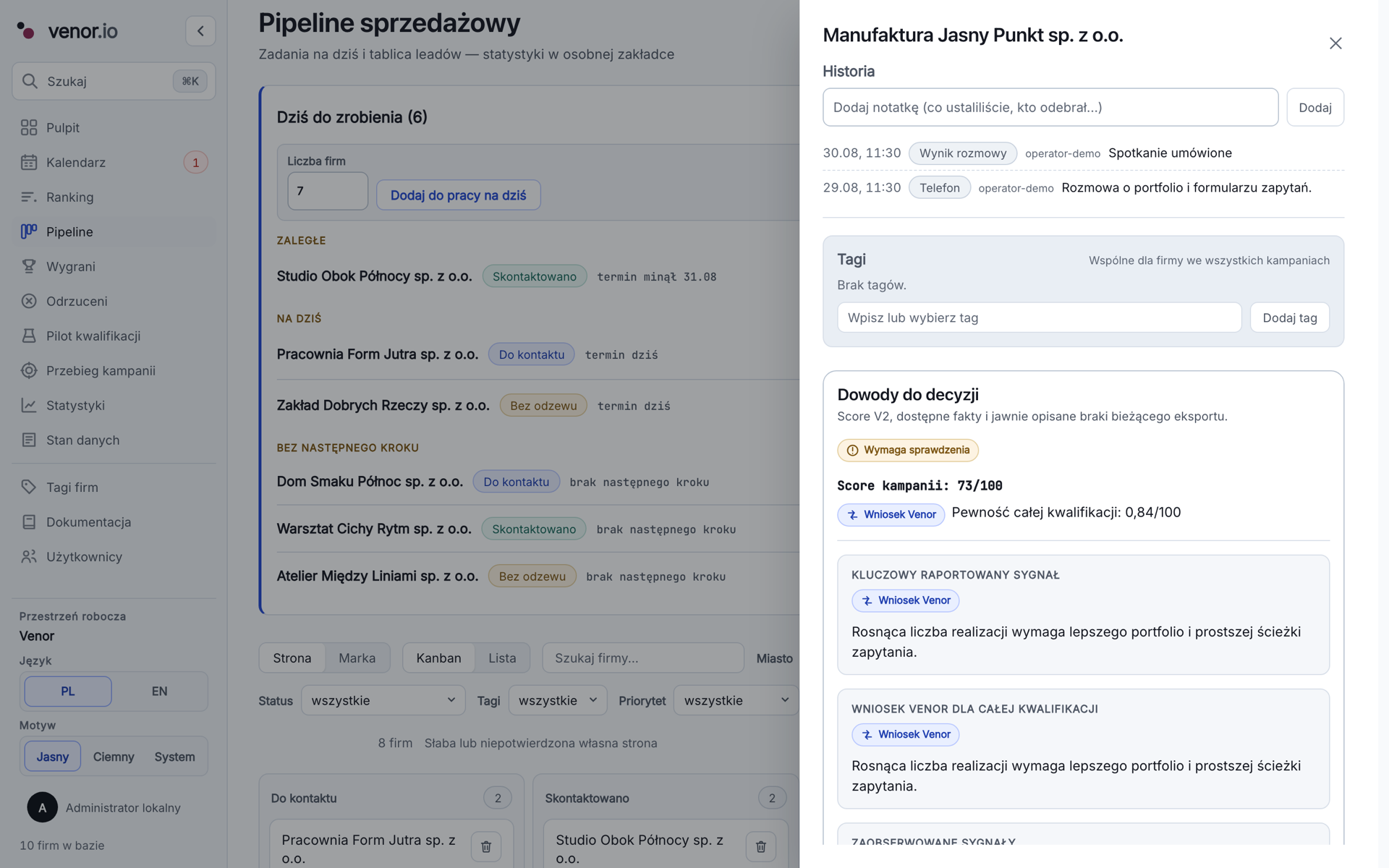
- The today queue: overdue, due and no-next-step items in one glance.
- Uncertainty gets a badge, not a footnote: a score that needs checking says so upfront.
- Data confidence is reported apart from the score, so the number does not pretend to be knowledge.
- Every conclusion quotes the signal it grew from.
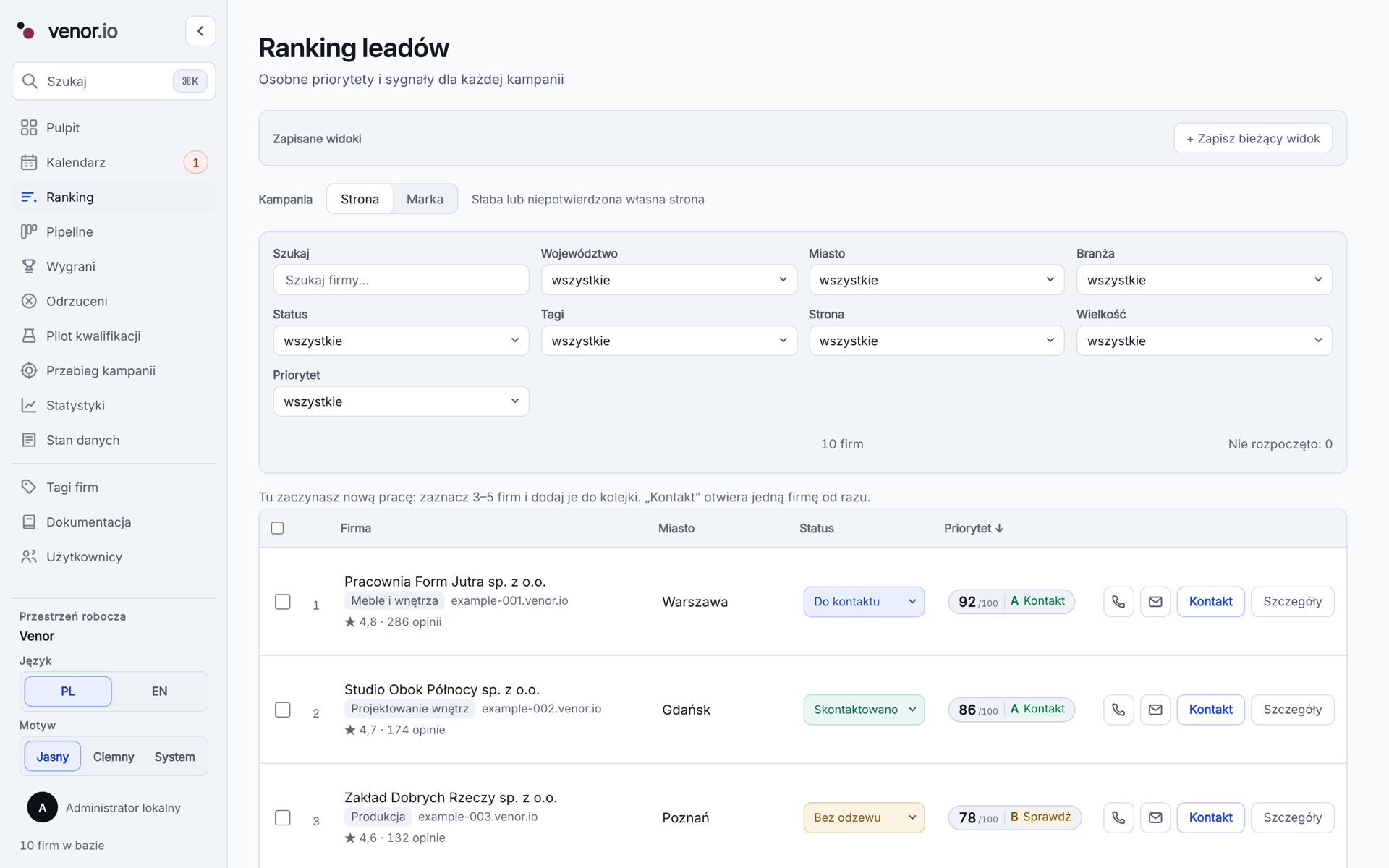
- Separate priorities per campaign instead of one global ranking.
- A number never stands alone: a priority band and a recommended action sit beside it.
- Actions on the row: from the ranking straight to contact, without switching views.
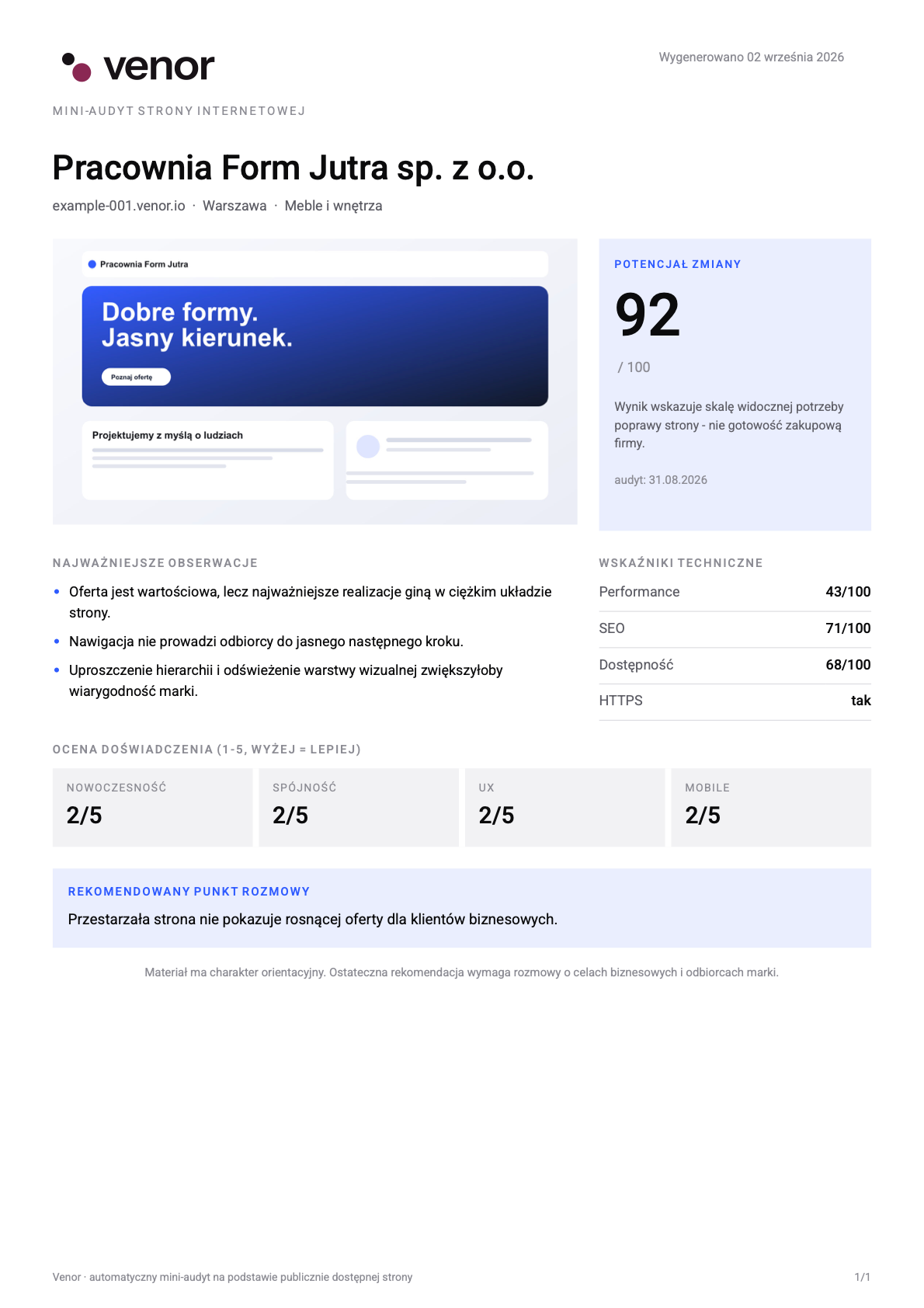
- The score named honestly: change potential, not the company's purchase readiness.
- Three observations instead of a wall of metrics.
- The audit ends in a recommended talking point, and the footer calls the material indicative.
Identity
The mark is one small observation yielding to a larger, counterweighted conclusion, set on a 45-degree bearing. It stays abstract on purpose, with no arrow, no chart, no network and no promise of an outcome: a relationship that has direction without claiming a result. It mirrors what Venor actually does: evidence becomes a reasoned next action, and nothing about a company's budget or intent is asserted.


The wordmark is always lowercase venor, set in Instrument Sans SemiBold (600) at −0.025em tracking, shipped as outlined glyph paths, so the lockup carries no runtime font dependency.
Mark explorations
The mark came out of 374 candidates across four rounds in three days: six geometric direction lanes first, then twenty-two research-driven lanes, then a form-locked refinement round, and finally an organic wave held to a curve-quality contract. The ten finalists are below; the winner, Final Weight, came from the refinement round.

Signal Trail

Closing Trace

Lattice V

Convergent Fix

Held Eclipse

Folded Ridge

Blue Limb

Steady Bearing

Bronze Sweep

Final Weight· final
Construction
The construction sits on a 64-unit grid: a small observation yields to a larger conclusion on a 45-degree bearing, and their shared, area-weighted centroid lands exactly at the centre of the box. The drawing itself carries the dimensions.
Color
The form was locked before any colour was chosen. Deep Mulberry #8A2853 was selected as the production direction on 2026-08-17, with a measured 8.05:1 contrast on Paper; on a dark field the core accent drops to 2.21:1, so a Night Mulberry variant is required there.
Deep Mulberry
#8A2853
the conclusion circle and brand accent on light surfaces
Brand Ink
#171216
the mark's observation, wordmark and primary text
Brand Paper
#FCFAFB
the primary editorial background
Mulberry Display
#D77BA2
the conclusion on dark fields (Night Mulberry)
Six explored-but-not-approved directions (cobalt, amber, pine, violet, coral and teal) are kept as decision history, not as options.


What this work does not claim
Venor detects fit, need and timing signals. It doesn't know whether a company has a budget or intends to buy, so the decision to reach out is always a person's. There are also deliberately no database sizes or scoring-accuracy figures here: one would advertise a private database of real companies, the other hasn't been measured.